
COVID Retrospective
Paywall removed on "When the Faces Were Obliterated"


Anthony Fauci testified before the Senate last week, invoking his 5th Amendment right against self-incrimination a hundred times. He no longer holds his position atop NIAID, but arguably, Fauci the man was never the real problem. He was but one office-holder in a system that selects for, and rewards, certain human types. The bigger issue is the role that “Science” has come to play as an instrument of discourse-policing and social sorting. It is a totem word deployed to create “permission structures” for believing X but not Y, which people in the institutional economy are especially sensitive to. We are only beginning to understand how the credentialed are susceptible to being cognitively steered for political advantage. Their sense of self depends on being conspicuously on the right side of a great moral divide (which gets masked as an epistemic divide). How else to account for the moralization of factual disputes, such that we end up with “hate facts” that are not to be admitted into one’s mind, on pain of social death? It is through such intimidation that you can manufacture a fake consensus, like the one about the emperor’s new clothes. But such forced consensus turns out to be brittle. All it takes is one prominent defection to create a cascade of defections, as happened with the lab leak hypothesis for Covid’s origins when the prominent science writer Nicholas Wade presented the facts straightforwardly in May 2021.
Maybe the public is now wised-up about the mechanisms by which consent is manufactured, as a result of the pandemic. But nothing has changed to interrupt the basic field of incentives. Big Science will always fellate its funding authority, which is either under political control or in the service of profit (both of which are orthogonal to the pursuit of truth). And for the foreseeable future, we have a form of class politics that sorts people on a faux-cognitive axis, creating pressure to conform that is hard for most people to resist.
So it seems a good time to recall just how fucked up things got in 2020-2021. We are going to do it again at some point. It is easy to dismiss the covering of faces as a thing of no account when people are dying. I won’t here re-litigate the factual questions about mortality rates, the efficacy of masks and social distancing, etc.. Who has the stomach for it? But on the human (or humanistic) side of the ledger, we do need to articulate, and never stop re-articulating, what is at stake with the loss of the face. Because it is a consideration has no lobby.
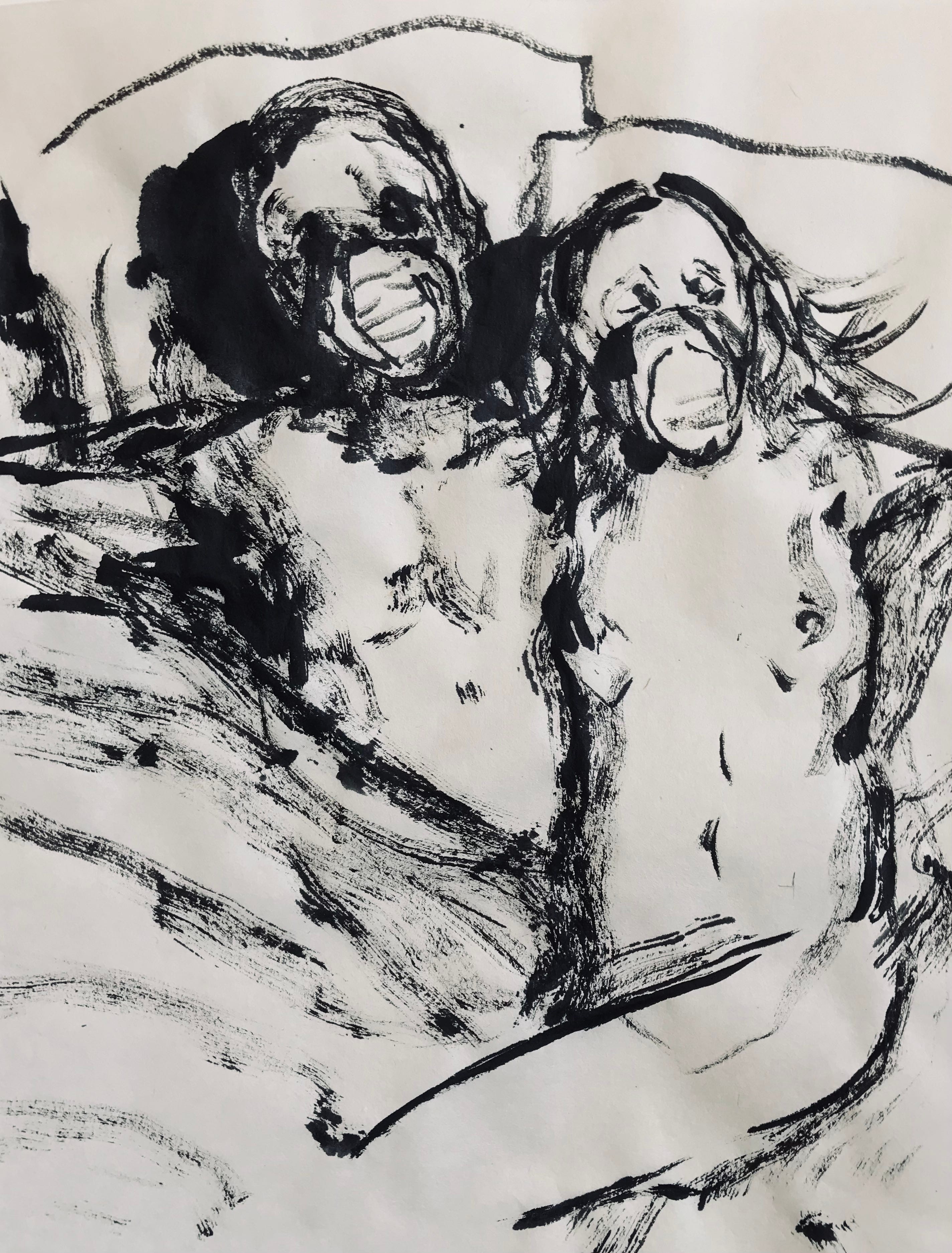
When I first posted the film “When the Faces Were Obliterated,” I got a DM from a reader named Thomas Crew (I highly recommend his Substack). In his September 2020 essay in The Critic on Ernst Jünger’s 1932 story The Worker, Crew wrote
…the uniformity of the new age is symbolised, Jünger suggests, by the sudden proliferation of the mask in contemporary society. “It is no coincidence”, he writes, “that the mask is again beginning to play a decisive role in public life. It is appearing in many different ways […]: be it as a gas mask, with which they are trying to equip entire populations; … be it as a safety mask for workplaces exposed to radiation, explosions, or narcotic substances. We can assume”, he continues, with an eerie prescience, “that the mask will come to take on functions that we can today hardly imagine.”
Given the sudden ubiquity of the face mask in 2020, across the entire globe and in an increasing number of social contexts, it is impossible to avoid the conclusion that this is precisely the sort of development Jünger had in mind. Our readiness to obscure the face reflects the dehumanising tendencies that, for Jünger, underlie the modern period. It represents another stage in the degradation of the individual that became explicit in the First World War.
With the Fauci drama currently in the news, it seems a good time to remove the paywall from the short film Christian Worthington and I made, “When the Faces Were Obliterated.” It is now posted to YouTube.
Thanks for reading and watching.
-Matt